equação Graceli estatística tensorial quântica de campos [ / IFF ] G* = / G / .= / G = [DR] = .= + + G* = = [ ] ω , , / T] / c [ [x,t] ] = |
 / IFF ]
  /
/ 
 G
G 
 /
/


//////
| Teoria | Interação | mediador | Magnitude relativa | Comportamento | Faixa |
|---|---|---|---|---|---|
| Cromodinâmica | Força nuclear forte | Glúon | 1041 | 1/r7 | 1,4 × 10⁻¹⁵ m |
| Eletrodinâmica | Força eletromagnética | Fóton | 1039 | 1/r2 | infinito |
| Flavordinâmica | Força nuclear fraca | Bósons W e Z | 1029 | 1/r5 até 1/r7 | 10-18 m |
| Geometrodinâmica | Força gravitacional | gráviton | 10 | 1/r2 | infinito |
G* = OPERADOR DE DIMENSÕES DE GRACELI.
DIMENSÕES DE GRACELI SÃO TODA FORMA DE TENSORES, ESTRUTURAS, ENERGIAS, ACOPLAMENTOS, , INTERAÇÕES E CAMPOS, DISTRIBUIÇÕES ELETRÔNICAS, E OUTROS.
In physics, Liouville field theory (or simply Liouville theory) is a two-dimensional conformal field theory whose classical equation of motion is a generalization of Liouville's equation.
Liouville theory is defined for all complex values of the central charge of its Virasoro symmetry algebra, but it is unitary only if

- ,
equação Graceli estatística tensorial quântica de campos [ / IFF ] G* = / G / .= / G = [DR] = .= + + G* = = [ ] ω , , / T] / c [ [x,t] ] = |
//////

and its classical limit is
- .
equação Graceli estatística tensorial quântica de campos [ / IFF ] G* = / G / .= / G = [DR] = .= + + G* = = [ ] ω , , / T] / c [ [x,t] ] = |
//////

Although it is an interacting theory with a continuous spectrum, Liouville theory has been solved. In particular, its three-point function on the sphere has been determined analytically.
Introduction[edit]
Liouville theory describes the dynamics of a field called the Liouville field, which is defined on a two-dimensional space. This field is not a free field due to the presence of an exponential potential

equação Graceli estatística tensorial quântica de campos [ / IFF ] G* = / G / .= / G = [DR] = .= + + G* = = [ ] ω , , / T] / c [ [x,t] ] = |
//////
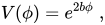
where the parameter is called the coupling constant. In a free field theory, the energy eigenvectors are linearly independent, and the momentum is conserved in interactions. In Liouville theory, momentum is not conserved.


Moreover, the potential reflects the energy eigenvectors before they reach , and two eigenvectors are linearly dependent if their momenta are related by the reflection

equação Graceli estatística tensorial quântica de campos [ / IFF ] G* = / G / .= / G = [DR] = .= + + G* = = [ ] ω , , / T] / c [ [x,t] ] = |
//////
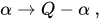
where the background charge is
equação Graceli estatística tensorial quântica de campos [ / IFF ] G* = / G / .= / G = [DR] = .= + + G* = = [ ] ω , , / T] / c [ [x,t] ] = |
//////

While the exponential potential breaks momentum conservation, it does not break conformal symmetry, and Liouville theory is a conformal field theory with the central charge
equação Graceli estatística tensorial quântica de campos [ / IFF ] G* = / G / .= / G = [DR] = .= + + G* = = [ ] ω , , / T] / c [ [x,t] ] = |
//////
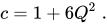
Under conformal transformations, an energy eigenvector with momentum transforms as a primary field with the conformal dimension by

equação Graceli estatística tensorial quântica de campos [ / IFF ] G* = / G / .= / G = [DR] = .= + + G* = = [ ] ω , , / T] / c [ [x,t] ] = |
//////

The central charge and conformal dimensions are invariant under the duality
equação Graceli estatística tensorial quântica de campos [ / IFF ] G* = / G / .= / G = [DR] = .= + + G* = = [ ] ω , , / T] / c [ [x,t] ] = |
//////

The correlation functions of Liouville theory are covariant under this duality, and under reflections of the momenta. These quantum symmetries of Liouville theory are however not manifest in the Lagrangian formulation, in particular the exponential potential is not invariant under the duality.
Spectrum and correlation functions[edit]
Spectrum[edit]
The spectrum of Liouville theory is a diagonal combination of Verma modules of the Virasoro algebra,

equação Graceli estatística tensorial quântica de campos [ / IFF ] G* = / G / .= / G = [DR] = .= + + G* = = [ ] ω , , / T] / c [ [x,t] ] = |
//////
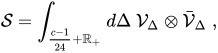
where and denote the same Verma module, viewed as a representation of the left- and right-moving Virasoro algebra respectively. In terms of momenta,


equação Graceli estatística tensorial quântica de campos [ / IFF ] G* = / G / .= / G = [DR] = .= + + G* = = [ ] ω , , / T] / c [ [x,t] ] = |
//////
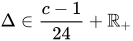
corresponds to
- .
equação Graceli estatística tensorial quântica de campos [ / IFF ] G* = / G / .= / G = [DR] = .= + + G* = = [ ] ω , , / T] / c [ [x,t] ] = |
//////
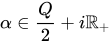
The reflection relation is responsible for the momentum taking values on a half-line, instead of a full line for a free theory.
Liouville theory is unitary if and only if . The spectrum of Liouville theory does not include a vacuum state. A vacuum state can be defined, but it does not contribute to operator product expansions.
Fields and reflection relation[edit]
In Liouville theory, primary fields are usually parametrized by their momentum rather than their conformal dimension, and denoted . Both fields and correspond to the primary state of the representation , and are related by the reflection relation


equação Graceli estatística tensorial quântica de campos [ / IFF ] G* = / G / .= / G = [DR] = .= + + G* = = [ ] ω , , / T] / c [ [x,t] ] = |
//////

where the reflection coefficient is[1]
equação Graceli estatística tensorial quântica de campos [ / IFF ] G* = / G / .= / G = [DR] = .= + + G* = = [ ] ω , , / T] / c [ [x,t] ] = |
//////

(The sign is if and otherwise, and the normalization parameter is arbitrary.)


Correlation functions and DOZZ formula[edit]
For , the three-point structure constant is given by the DOZZ formula (for Dorn–Otto[2] and Zamolodchikov–Zamolodchikov[3]),

equação Graceli estatística tensorial quântica de campos [ / IFF ] G* = / G / .= / G = [DR] = .= + + G* = = [ ] ω , , / T] / c [ [x,t] ] = |
//////
![{\displaystyle C_{\alpha _{1},\alpha _{2},\alpha _{3}}={\frac {\left[b^{{\frac {2}{b}}-2b}\lambda \right]^{Q-\alpha _{1}-\alpha _{2}-\alpha _{3}}\Upsilon _{b}'(0)\Upsilon _{b}(2\alpha _{1})\Upsilon _{b}(2\alpha _{2})\Upsilon _{b}(2\alpha _{3})}{\Upsilon _{b}(\alpha _{1}+\alpha _{2}+\alpha _{3}-Q)\Upsilon _{b}(\alpha _{1}+\alpha _{2}-\alpha _{3})\Upsilon _{b}(\alpha _{2}+\alpha _{3}-\alpha _{1})\Upsilon _{b}(\alpha _{3}+\alpha _{1}-\alpha _{2})}}\ ,}](https://wikimedia.org/api/rest_v1/media/math/render/svg/983b01ce1618b4dca2710709b88f4680314662e0)
where the special function is a kind of multiple gamma function.

For , the three-point structure constant is[1]
equação Graceli estatística tensorial quântica de campos [ / IFF ] G* = / G / .= / G = [DR] = .= + + G* = = [ ] ω , , / T] / c [ [x,t] ] = |
//////
![{\displaystyle {\hat {C}}_{\alpha _{1},\alpha _{2},\alpha _{3}}={\frac {\left[(ib)^{{\frac {2}{b}}-2b}\lambda \right]^{Q-\alpha _{1}-\alpha _{2}-\alpha _{3}}{\hat {\Upsilon }}_{b}(0){\hat {\Upsilon }}_{b}(2\alpha _{1}){\hat {\Upsilon }}_{b}(2\alpha _{2}){\hat {\Upsilon }}_{b}(2\alpha _{3})}{{\hat {\Upsilon }}_{b}(\alpha _{1}+\alpha _{2}+\alpha _{3}-Q){\hat {\Upsilon }}_{b}(\alpha _{1}+\alpha _{2}-\alpha _{3}){\hat {\Upsilon }}_{b}(\alpha _{2}+\alpha _{3}-\alpha _{1}){\hat {\Upsilon }}_{b}(\alpha _{3}+\alpha _{1}-\alpha _{2})}}\ ,}](https://wikimedia.org/api/rest_v1/media/math/render/svg/a1a05a39256684764356d8884b7d45584c085175)
where
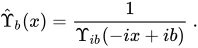
-point functions on the sphere can be expressed in terms of three-point structure constants, and conformal blocks. An -point function may have several different expressions: that they agree is equivalent to crossing symmetry of the four-point function, which has been checked numerically[3][4] and proved analytically.[5][6]

Liouville theory exists not only on the sphere, but also on any Riemann surface of genus . Technically, this is equivalent to the modular invariance of the torus one-point function. Due to remarkable identities of conformal blocks and structure constants, this modular invariance property can be deduced from crossing symmetry of the sphere four-point function.[7][4]

Uniqueness of Liouville theory[edit]
Using the conformal bootstrap approach, Liouville theory can be shown to be the unique conformal field theory such that[1]
- the spectrum is a continuum, with no multiplicities higher than one,
- the correlation functions depend analytically on and the momenta,
- degenerate fields exist.
Lagrangian formulation[edit]
Action and equation of motion[edit]
Liouville theory is defined by the local action
equação Graceli estatística tensorial quântica de campos [ / IFF ] G* = / G / .= / G = [DR] = .= + + G* = = [ ] ω , , / T] / c [ [x,t] ] = |
//////
![{\displaystyle S[\phi ]={\frac {1}{4\pi }}\int d^{2}x{\sqrt {g}}(g^{\mu \nu }\partial _{\mu }\phi \partial _{\nu }\phi +QR\phi +\lambda 'e^{2b\phi })\ ,}](https://wikimedia.org/api/rest_v1/media/math/render/svg/3522fb763ae2b2377634fe8e6b77922b0f91cf04)
where is the metric of the two-dimensional space on which the theory is formulated, is the Ricci scalar of that space, and is the Liouville field. The parameter , which is sometimes called the cosmological constant, is related to the parameter that appears in correlation functions by


- .
equação Graceli estatística tensorial quântica de campos [ / IFF ] G* = / G / .= / G = [DR] = .= + + G* = = [ ] ω , , / T] / c [ [x,t] ] = |
//////
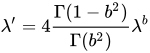
The equation of motion associated to this action is
equação Graceli estatística tensorial quântica de campos [ / IFF ] G* = / G / .= / G = [DR] = .= + + G* = = [ ] ω , , / T] / c [ [x,t] ] = |
//////

where is the Laplace–Beltrami operator. If is the Euclidean metric, this equation reduces to

equação Graceli estatística tensorial quântica de campos [ / IFF ] G* = / G / .= / G = [DR] = .= + + G* = = [ ] ω , , / T] / c [ [x,t] ] = |
//////

which is equivalent to Liouville's equation.
Once compactified on a cylinder, Liouville field theory can be equivalently formulated as a worldline theory.[8]
Conformal symmetry[edit]
Using a complex coordinate system and a Euclidean metric

- ,
equação Graceli estatística tensorial quântica de campos [ / IFF ] G* = / G / .= / G = [DR] = .= + + G* = = [ ] ω , , / T] / c [ [x,t] ] = |
//////

the energy–momentum tensor's components obey
equação Graceli estatística tensorial quântica de campos [ / IFF ] G* = / G / .= / G = [DR] = .= + + G* = = [ ] ω , , / T] / c [ [x,t] ] = |
//////

The non-vanishing components are
equação Graceli estatística tensorial quântica de campos [ / IFF ] G* = / G / .= / G = [DR] = .= + + G* = = [ ] ω , , / T] / c [ [x,t] ] = |
//////

Each one of these two components generates a Virasoro algebra with the central charge
- .
equação Graceli estatística tensorial quântica de campos [ / IFF ] G* = / G / .= / G = [DR] = .= + + G* = = [ ] ω , , / T] / c [ [x,t] ] = |
//////

For both of these Virasoro algebras, a field is a primary field with the conformal dimension
- .
equação Graceli estatística tensorial quântica de campos [ / IFF ] G* = / G / .= / G = [DR] = .= + + G* = = [ ] ω , , / T] / c [ [x,t] ] = |
//////

For the theory to have conformal invariance, the field that appears in the action must be marginal, i.e. have the conformal dimension

- .

This leads to the relation
equação Graceli estatística tensorial quântica de campos [ / IFF ] G* = / G / .= / G = [DR] = .= + + G* = = [ ] ω , , / T] / c [ [x,t] ] = |
//////

between the background charge and the coupling constant. If this relation is obeyed, then is actually exactly marginal, and the theory is conformally invariant.
Path integral[edit]
The path integral representation of an -point correlation function of primary fields is
equação Graceli estatística tensorial quântica de campos [ / IFF ] G* = / G / .= / G = [DR] = .= + + G* = = [ ] ω , , / T] / c [ [x,t] ] = |
//////
![{\displaystyle \left\langle \prod _{i=1}^{N}V_{\alpha _{i}}(z_{i})\right\rangle =\int D\phi \ e^{-S[\phi ]}\prod _{i=1}^{N}e^{2\alpha _{i}\phi (z_{i})}\ .}](https://wikimedia.org/api/rest_v1/media/math/render/svg/584ed9d5617f0d8c4ada09487f49f34fad52e9c8)
It has been difficult to define and to compute this path integral. In the path integral representation, it is not obvious that Liouville theory has exact conformal invariance, and it is not manifest that correlation functions are invariant under and obey the reflection relation. Nevertheless, the path integral representation can be used for computing the residues of correlation functions at some of their poles as Dotsenko–Fateev integrals in the Coulomb gas formalism, and this is how the DOZZ formula was first guessed in the 1990s. It is only in the 2010s that a rigorous probabilistic construction of the path integral was found, which led to a proof of the DOZZ formula[9] and the conformal bootstrap.[6][10]

Relations with other conformal field theories[edit]
Some limits of Liouville theory[edit]
When the central charge and conformal dimensions are sent to the relevant discrete values, correlation functions of Liouville theory reduce to correlation functions of diagonal (A-series) Virasoro minimal models.[1]
On the other hand, when the central charge is sent to one while conformal dimensions stay continuous, Liouville theory tends to Runkel–Watts theory, a nontrivial conformal field theory (CFT) with a continuous spectrum whose three-point function is not analytic as a function of the momenta.[11] Generalizations of Runkel-Watts theory are obtained from Liouville theory by taking limits of the type .[4] So, for , two distinct CFTs with the same spectrum are known: Liouville theory, whose three-point function is analytic, and another CFT with a non-analytic three-point function.


WZW models[edit]
Liouville theory can be obtained from the Wess–Zumino–Witten model by a quantum Drinfeld–Sokolov reduction. Moreover, correlation functions of the model (the Euclidean version of the WZW model) can be expressed in terms of correlation functions of Liouville theory.[12][13] This is also true of correlation functions of the 2d black hole coset model.[12] Moreover, there exist theories that continuously interpolate between Liouville theory and the model.[14]


Conformal Toda theory[edit]
Liouville theory is the simplest example of a Toda field theory, associated to the Cartan matrix. More general conformal Toda theories can be viewed as generalizations of Liouville theory, whose Lagrangians involve several bosons rather than one boson , and whose symmetry algebras are W-algebras rather than the Virasoro algebra.

Supersymmetric Liouville theory[edit]
Liouville theory admits two different supersymmetric extensions called supersymmetric Liouville theory and supersymmetric Liouville theory.[15]


Relations with integrable models[edit]
Sinh-Gordon model[edit]
In flat space, the sinh-Gordon model is defined by the local action:
equação Graceli estatística tensorial quântica de campos [ / IFF ] G* = / G / .= / G = [DR] = .= + + G* = = [ ] ω , , / T] / c [ [x,t] ] = |
//////
![{\displaystyle S[\phi ]={\frac {1}{4\pi }}\int d^{2}x\left(\partial ^{\mu }\phi \partial _{\mu }\phi +\lambda \cosh(2b\phi )\right)}](https://wikimedia.org/api/rest_v1/media/math/render/svg/e2bae597a2b1b8259f8c6842f62ce1d02198eab4)
The corresponding classical equation of motion is the sinh-Gordon equation. The model can be viewed as a perturbation of Liouville theory. The model's exact S-matrix is known in the weak coupling regime , and it is formally invariant under . However, it has been argued that the model itself is not invariant.[16]


Comentários
Postar um comentário